Rome Triennale 2014 — Tiltestetica
An official review from the Rome Triennale, exploring the introspective and symbolic art of Aurora Mazzoldi, published in the volume “Tiltestetica”.
“Aurora Mazzoldi's painting is symbolic, esoteric, romantic; it narrates the inner reality, the face behind the mask, the psychological mechanisms each of us has chosen to embody.”
Aurora Mazzoldi at the Rome Triennale 2014
In the official volume Tiltestetica (Editoriale Giorgio Mondadori), published on the occasion of the Rome Triennale 2014 and curated by Prof. Daniele Radini Tedeschi, the figure of Aurora Mazzoldi is presented with a critical essay written by Federica Peligra, entitled “The Artists of Our Time”.
The review describes Mazzoldi's art as:
- “Symbolic, esoteric, romantic”
- Deeply oriented toward the narration of interiority, of psychological mechanisms and of the roles each of us chooses to interpret in daily life.
- “An introspective art, a form of visual philosophy”, able to transform the painting into a mirror of the soul.
Themes and stylistic recognizability
According to the critic, each painting is a symbolic narrative built through:
- The semiotic care of detail
- The evocative use of color
- The decisive importance of the title, which “represents the arcane message”.
It is emphasized how the acrylic technique chosen by the artist succeeds in blending strength and delicacy: capable of evoking both watercolor and oil, it becomes the ideal medium to reveal the most hidden part of the psyche.
Key excerpts from the review:
“Mazzoldi represents psychological games, roles and mechanisms that operate in each of us, revealing how everyone has chosen (and this is the key word) to be.”
“Introspective art is also a school of thought: it invites one to reflect on one's actions, to read the inner signals. Change is possible, and only we can make it happen.”
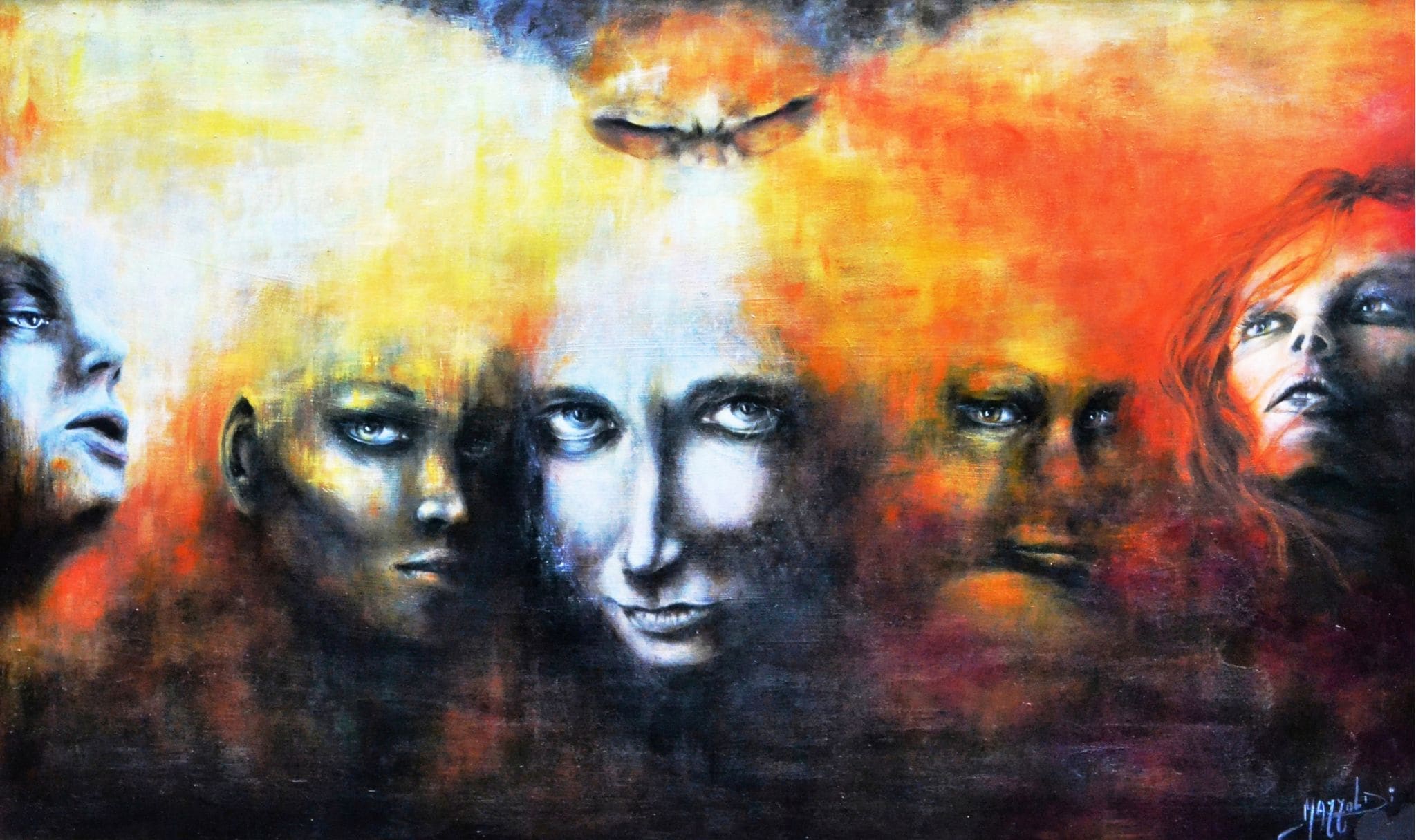
“Emotions are personified by images full of color that emerge from evanescent backgrounds. An almost auroral light strikes the subjects, like a visual redemption.”
Sample works analyzed in the review:
- Witches – symbolic acrylic painting, representing female personalities trapped in the mind
- The Room of Mirrors – visual interpretation of an inner state in transformation
- Italy Looking for Work – socio-political collage exhibited at the Triennale
Central themes of Aurora Mazzoldi's work, according to the critic: – Introspection as a key to existential reading – Conscious symbolism in the pictorial gesture – Art as a mirror of the psyche – Light as a visual metaphor of transformation – The active role of the viewer in understanding the work
Critical Insight – Mazzoldi's Inner Language
“Aurora Mazzoldi was born in Arco di Trento and, after living across Europe (Paris, Vienna, London), returned to work and live in the province of Trento. Her painting is symbolic, esoteric, romantic; her works tell a story, that of inner reality, of the face behind the mask, of existential attitudes. Narratives between people, or between people and objects, with an attention – indeed, a research – towards the deepest levels of the unconscious, towards introspection. She is an artist in search of truth, which in her view is certainly not that of appearances.
Among the most important exhibitions she has taken part in abroad are those at the Agora Gallery in New York (2007 and 2008) and at the Museum of the Americas in Miami (2008); in Italy, several museum exhibitions organized by La Rosa dei Venti. We have said that Aurora Mazzoldi's art is introspective art; she herself defines it as art for the curious of the psyche. An art that conveys a deeper inner message, capable of entering directly into contact with certain aspects of psychology.
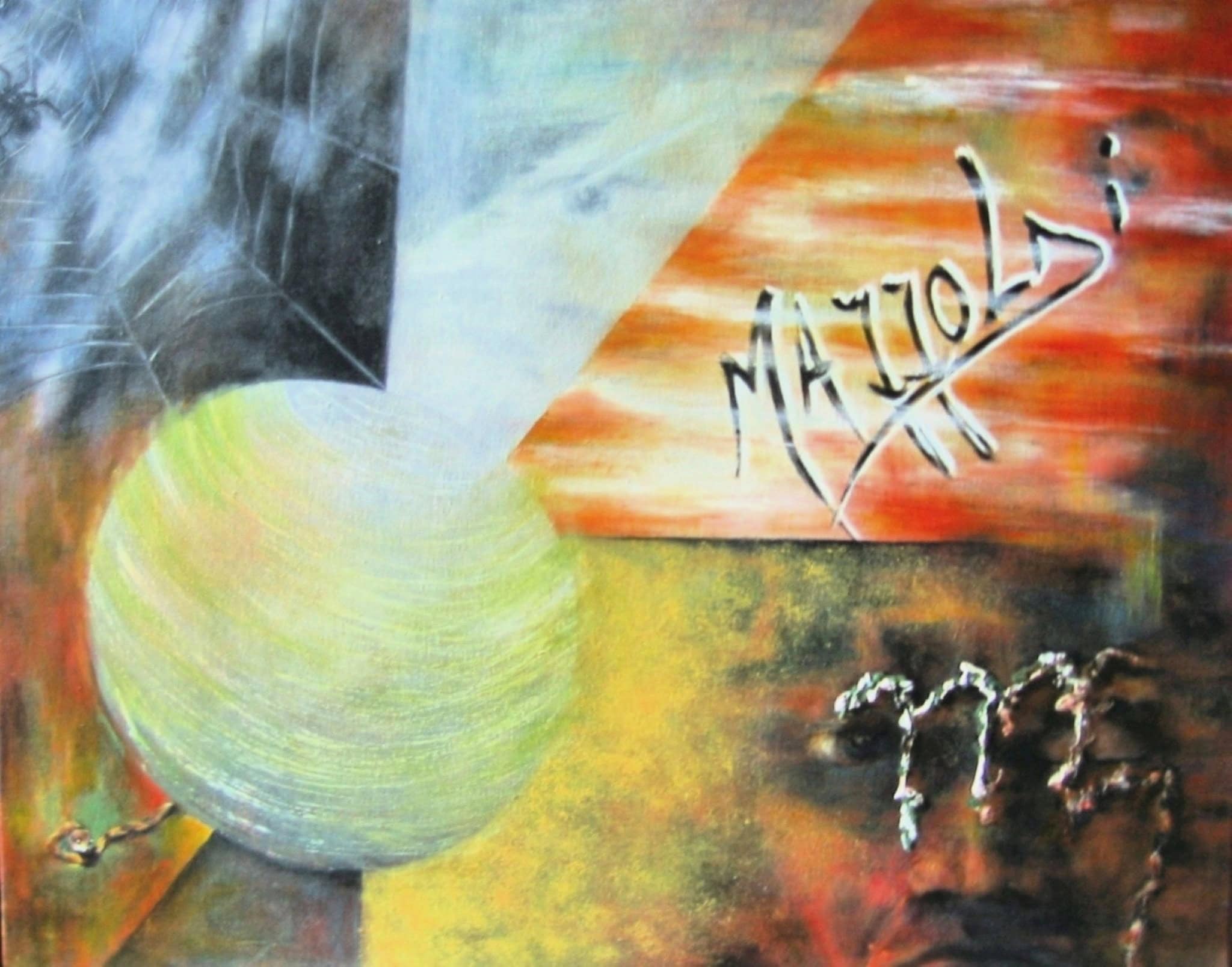
The material of which the work is composed takes form directly from an inner search by the artist, exteriorized on the canvas, as if each time it told a story, with symbolic details revealing a reality usually hidden.
She expressly states that she represents psychological games, attitudes, roles, and mechanisms that act in each of us, revealing how each person has organized their way of living, how each one has chosen (and this is the key word) to be.
To understand Aurora Mazzoldi's works, one must carefully read the titles, which represent the arcane message. Nothing is left to chance: for every detail, every color, every symbol there is an explanation.
Introspective art does not stop at superficial emotions; for Aurora Mazzoldi, every situation we experience is or will be the consequence of our choices, with little space left to chance or destiny.
Introspective art issues a warning: to pay attention, or at least to reflect on how one is acting today. It sometimes shows the consequences, the damage that can arise from a possessive love that ends up castrating its object, or from an oppressive attitude.
Introspective art is also a school of thought, a philosophy of life and a teaching for those with a mind open enough to grasp it: that of reflecting on one's actions, because for our artist change is possible – and only we can make it happen.
Some works are more figurative, such as “Witches”, in which the types of women who have closed their hearts in the mental sphere are represented. Other paintings are more symbolic, such as “The Room of Mirrors”, which portrays inner states in motion.
The technical medium most suited to representing these mental interactions is acrylic, which, in a more romantic sense, manages to reveal what lies beneath the surface. Mazzoldi considers acrylic a modern medium, allowing her to imitate both the nuances of watercolor and the impact force of oil painting.
The search for the innermost and most hidden part of human beings is what gives her works their magical and esoteric character.
Attempts have often been made to “define” Aurora Mazzoldi, to give her a label. Many, especially in New York, have seen her as a romantic of our time. However, her art is also one of vibrations, expressive, bold in her chromatic choices, but above all in the choice of themes. Her art is investigation, almost a life mission: to test the strength of human will, capable of changing not only one's own destiny, but also that of others.
Mazzoldi prefers to make art starting from what happens inside rather than focusing on everything that happens outside of herself and of human beings in general.
Introspective art is therefore based on a long process, generated not only by the creative and artistic act in the strict sense, but also by the entire preceding phase, based on self-reflection. A long and complex procedure, made up of pauses and restarts, of which the fixation on canvas represents only the final stage. The observer also plays a part: he or she must carry out the work of understanding and perhaps re-internalizing the contained message. It is a sort of Ringkomposition in which one starts from the inner self and, at the end of the journey, returns there once again.
The romanticism of which our artist is a bearer is a consequence of all this: it represents a way of experiencing life, based on the search for poetry. With a romantic soul, she is able to “soften” even the darkest and most obscure aspects present in each of us.
Mazzoldi does not deny this part; on the contrary, she exalts it, shading it into softer forms than those that might appear in our unconscious. In fact, rigid, harsh, or angular figures never appear.
Hers is a painting of light, almost unreal, or rather, surreal. Such enveloping atmospheres capture the figures, who appear immersed in a perennial haze. The emotions that the artist wishes to convey are personified by images full of color, standing out from a more evanescent background. This light, almost auroral and mystical, striking her subjects, seems like the light of redemption that falls upon the repentant sinner, allowing them to start again from reflection on their own being.
The artist's works thus depict exemplary positions and situations that everyone often experiences; with a sort of vaticinium, Mazzoldi amplifies and unveils the dramatic consequences so as not to fall into error, not to linger in mistake.
Vices and flaws of humankind in reciprocal relationships emerge from her canvases: from the expressions of the subjects, from their grimaces or their pain, from the nuances, from the chromatic rendering. Mazzoldi's art acts as a probe of human conscience, giving new vitality to that current of Introspective Psychology popular in the 20th century. Now, thanks to the psychological reading of the works applied by Dr. Antonella Giannini, the significance of each of Mazzoldi's paintings expands its reach.
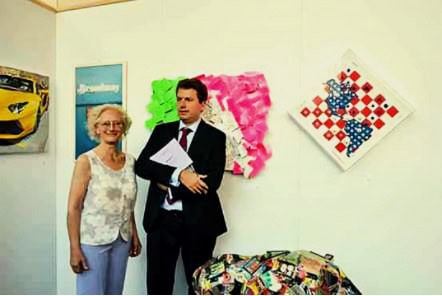
The only work apparently different from the artist's production is the collage exhibited at the 2014 Rome Triennale of Visual Arts, entitled “Italy Looking for Work”. As one can see, the canvas is covered with numerous fluorescent notes, becoming a large noticeboard located in a museum rather than along the corridor of an employment office!
Announcements whose leading theme is the rampant economic crisis that generates a demand for work in every occupational field. Even through this work—certainly with content more explicit than implied—the artist becomes the spokesperson for a restlessness that is not only personal but, rather, universal.
It would be interesting to imagine how the artist might transpose this state of mind into a figurative painting in which the interaction between “two fundamentals” is rendered in the relationship between an employer and a dismissed employee. Two extremely contrasting “existential positions” would emerge, in a work well suited to adorn the office of an unjust entrepreneur.
Clear in the artist's research is the reference to the theories of Transactional Analysis linked to Eric Leonard Bernstein (Eric Berne), in which the aim is for emotions—often harmful to relationships—to be managed in the correct way in order to improve our relationship with otherness.
Original works, if we consider all the thought that pervades them and the artist's primary intention which, rather than satisfying a passion or an inclination, generously places herself at the service of the community.
Critic: Federica Peligra Review Title: “Tiltestetica — The Inner Language of Mazzoldi” Year: 2014 Origin: Official catalog of the Rome Triennale Publication: Tiltestetica — The Book of the Rome Triennale 2014, curated by Daniele Radini Tedeschi, Editoriale Giorgio Mondadori, pp. 316–318